Are you an expecting parent eager to guess your baby’s gender in 2025? From quirky old wives’ tales gender prediction methods to the ancient Chinese gender prediction 2025 calendar, the options are endless and intriguing. At BabyPredicts.com, we explore these traditional baby gender prediction methods, comparing their fun factor with their accuracy to help you decide what works best. Whether you’re planning a gender reveal or simply curious, this guide dives deep into the world of folklore versus cultural tools, all tailored for today’s moms-to-be.
The Fascination with Gender Prediction
Pregnancy is a time of wonder, and knowing your baby’s gender adds an extra layer of excitement. In 2025, with medical options like ultrasounds and NIPT offering near-certain results, traditional methods like old wives’ tales and the Chinese gender predictor remain popular for their early, non-invasive appeal. These methods tap into human curiosity and cultural heritage, making them a beloved pastime for expecting families.
What Are Old Wives’ Tales for Gender Prediction?
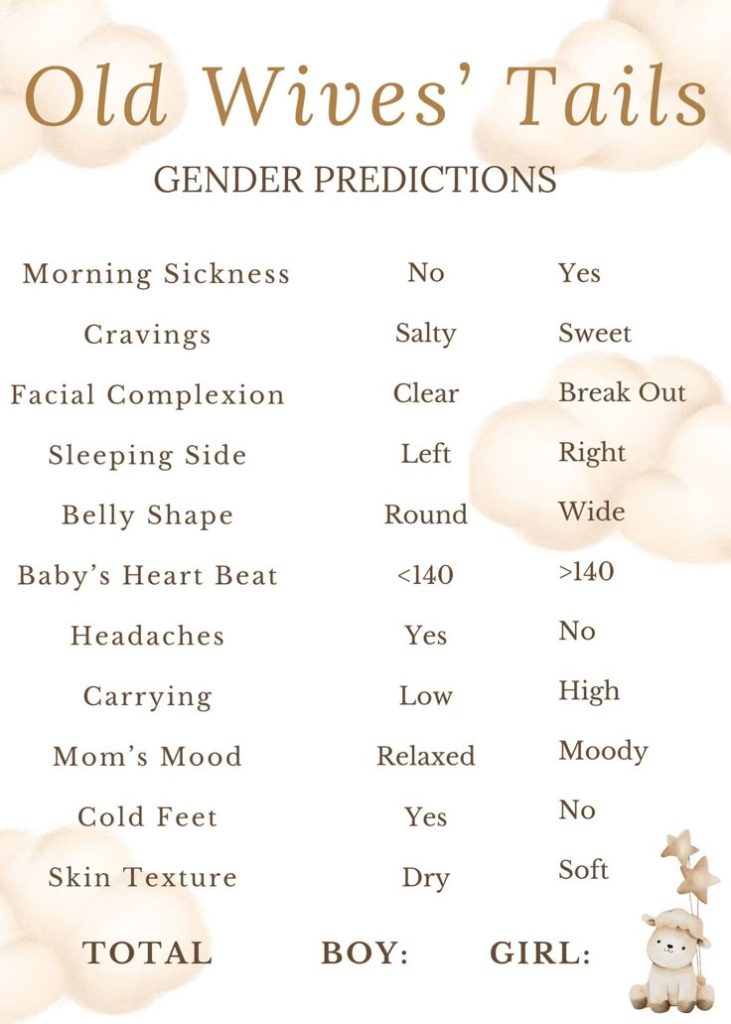
Old wives’ tales are traditional beliefs passed down through generations, often based on observations of pregnancy symptoms or behaviors. These tales offer a playful way to predict whether you’re having a boy or girl without medical intervention. Here are some popular examples:
- Cravings: Sweet cravings supposedly indicate a girl, while salty or sour cravings suggest a boy. For instance, a mom craving chocolate might jokingly predict a daughter.
- Bump Shape: A high, round bump is said to mean a girl, while a low, wide bump hints at a boy. This tale often sparks debates among friends and family.
- Heart Rate: A fetal heart rate above 140 beats per minute is linked to girls, while below 140 suggests boys—though this varies throughout pregnancy.
- Skin Changes: Clear, glowing skin might mean a boy, while breakouts are thought to signal a girl “stealing” your beauty.
- Ring Test: Dangle a ring on a string over your belly; a circular swing predicts a girl, while a back-and-forth motion indicates a boy.
These tales, rooted in folklore, are easy to try at home and often become conversation starters at baby showers. However, their accuracy is questionable, relying more on chance than science.
Understanding the Chinese Gender Prediction Method
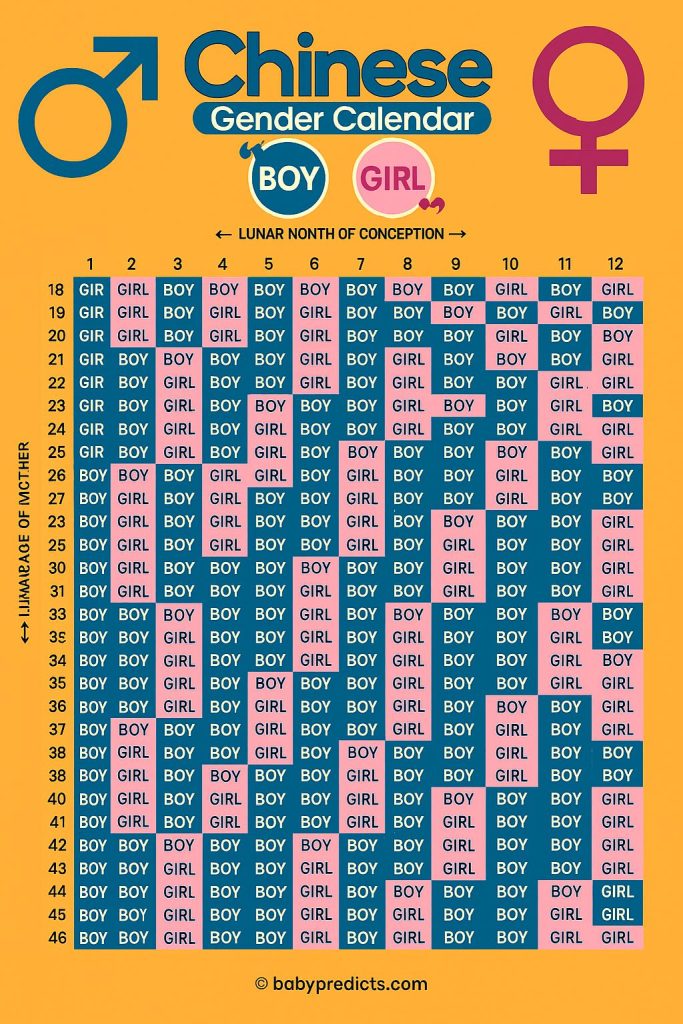
The Chinese gender prediction 2025 method, also known as the Chinese gender calendar or birth chart, is an ancient tool believed to date back over 700 years. Discovered in a royal tomb near Beijing, it uses the mother’s lunar age and the lunar month of conception to predict gender. Here’s how it works:
- Lunar Age Calculation: Add one or two years to your Western age based on the Chinese New Year and your birth date.
- Lunar Conception Month: Convert your conception date (about two weeks post-last menstrual period) to the lunar calendar.
- Chart Reference: Match these on a grid to find the predicted gender—boy or girl.
Available on sites like BabyPredicts.com, this method combines astrology and lunar cycles, offering a structured yet mystical approach compared to old wives’ tales.
Historical and Cultural Roots
Old wives’ tales likely emerged from rural communities observing pregnancy patterns, evolving into shared wisdom over centuries. The Chinese gender prediction, tied to imperial China, reflects a historical preference for male heirs and integrates elements of the I Ching and Five Elements. In 2025, both methods persist as cultural touchstones, appealing to parents seeking tradition amid modern medical advancements.
Accuracy: Old Wives’ Tales vs. Chinese Gender Prediction
The burning question for 2025 expecting parents is: What works? Let’s break it down.
Accuracy of Old Wives’ Tales
Scientific studies, including those from the National Library of Medicine, show old wives’ tales have no predictive power beyond a 50% chance—equivalent to flipping a coin. For example:
- Cravings: No link exists between food preferences and gender; cravings reflect nutritional needs or hormonal changes.
- Heart Rate: Fetal heart rates vary naturally (110–160 bpm), debunking the 140 bpm myth.
- Bump Shape: Bump appearance depends on body type, muscle tone, and baby position, not gender.
Anecdotes may suggest accuracy, but this is likely confirmation bias or random luck. In 2025, these tales are best enjoyed as entertainment.
Accuracy of Chinese Gender Prediction
The Chinese gender calendar claims 90% accuracy in popular lore, but research tells a different story. A University of Michigan study analyzing 2.8 million births found a 50% accuracy rate—again, chance-based. The lunar age and conception month don’t influence the X or Y chromosome from the father’s sperm, the true gender determinant. Variations in chart versions and calculation errors further reduce reliability.
Head-to-Head Comparison
Both methods hover around 50% accuracy, lacking scientific validation. Medical options like ultrasounds (95–99% accurate from 18–22 weeks) and NIPT (over 99% accurate from 10 weeks) far outperform them. In 2025, the choice between the two hinges on fun versus function.
Pros and Cons of Each Method
Old Wives’ Tales
- Pros: Free, accessible, and socially engaging; no tools needed.
- Cons: Unreliable, inconsistent, and can lead to false expectations if taken seriously.
Chinese Gender Prediction
- Pros: Structured, culturally rich, and available online (e.g., BabyPredicts.com); offers an early guess.
- Cons: Requires accurate lunar calculations, prone to errors, and still 50% accurate.
Why People Use These Methods in 2025
Despite their limitations, both methods thrive in 2025 for:
- Early Anticipation: They provide guesses before medical confirmation, building excitement.
- Cultural Appeal: Old wives’ tales connect to family traditions, while the Chinese calendar ties to heritage.
- Social Media Trends: Gender prediction challenges on platforms like TikTok keep these methods relevant.
How to Use Old Wives’ Tales and Chinese Prediction
Trying Old Wives’ Tales
- Gather friends for a prediction party: test cravings, bump shape, and the ring test.
- Keep a lighthearted approach, recording results for fun comparison later.
Using the Chinese Gender Predictor
- Visit BabyPredicts.com for a reliable tool.
- Input your lunar age and conception month carefully, treating the result as a game.
Enhancing the Experience
Combine methods for a fuller prediction story. For example, if the Chinese calendar predicts a boy and your bump is low, share the “evidence” with your community. Add a gender reveal twist with colored cakes or balloons to celebrate the guesswork.
The Science Behind Gender Determination
Gender is set at conception by the sperm’s X or Y chromosome pairing with the egg’s X, resulting in XX (girl) or XY (boy). Neither lunar cycles nor pregnancy symptoms influence this, explaining why traditional methods fall short. In 2025, genetic insights reinforce medical testing as the only accurate approach.
Risks of Over-Reliance
- Disappointment: Wrong predictions can dampen excitement.
- Delayed Care: Focusing on folklore might delay essential prenatal checks.
- Cultural Pressure: In gender-preferring cultures, inaccurate guesses could heighten stress.
Experts in 2025 advise using these methods for fun, not decision-making.
Modern Alternatives in 2025
For accuracy, consider:
- Ultrasound: 95–99% accurate from 18–22 weeks.
- NIPT: Over 99% accurate from 10 weeks, analyzing fetal DNA.
- Amniocentesis/CVS: Nearly 100% accurate but used for medical reasons.
These options, available through healthcare providers, outshine traditional methods.
Fun Prediction Games Beyond 2025
- Mayan Method: Odd/even age and year combo predicts gender.
- Baking Soda Test: Urine reaction (fizz for boy, flat for girl) adds a quirky twist.
- Nub Theory: Early ultrasound angle guesses, though still 50% accurate.
These keep the prediction spirit alive with minimal stakes.
Building a Prediction Community
Share your results on BabyPredicts.com forums or social media. Host a virtual prediction party with friends, pooling tales and calendar guesses for a collective experience.
Why Choose BabyPredicts.com?
At BabyPredicts.com, we offer the best Chinese gender predictor tool and a supportive community for 2025 moms. Explore our resources to enjoy prediction fun while staying informed about medical options.
FAQs About Old Wives’ Tales vs. Chinese Gender Prediction
Q: Are old wives’ tales more accurate than the Chinese gender predictor?
A: No, both are approximately 50% accurate, matching random chance, with no scientific basis.
Q: Can I use the Chinese gender prediction before an ultrasound?
A: Yes, it’s an early option, but it’s not reliable—use it for fun before medical confirmation at 18–22 weeks.
Q: Why do some predictions seem to work?
A: With only two outcomes, 50% success is expected by luck, amplified by confirmation bias.
Q: Is the Chinese gender calendar updated for 2025?
A: No, it uses the same lunar-based chart, adjusted only by your input, not yearly updates.
Q: Can diet or lifestyle affect these predictions?
A: No, gender is determined by chromosomes at conception, unaffected by diet or lunar cycles.
Q: Should I plan my nursery based on these methods?
A: No, rely on medical tests for accuracy to avoid costly redecorating if predictions fail.
Q: How can I make prediction fun without stress?
A: Treat it as a game, share with friends, and use BabyPredicts.com tools for added enjoyment.
Conclusion
In 2025, old wives’ tales vs. Chinese gender prediction offers a delightful dive into tradition, but neither works as a reliable baby gender prediction method. With 50% accuracy each, they’re best for entertainment, not planning. For certainty, turn to ultrasounds or NIPT. Visit BabyPredicts.com for our Chinese gender predictor and community support to enjoy this journey with confidence!