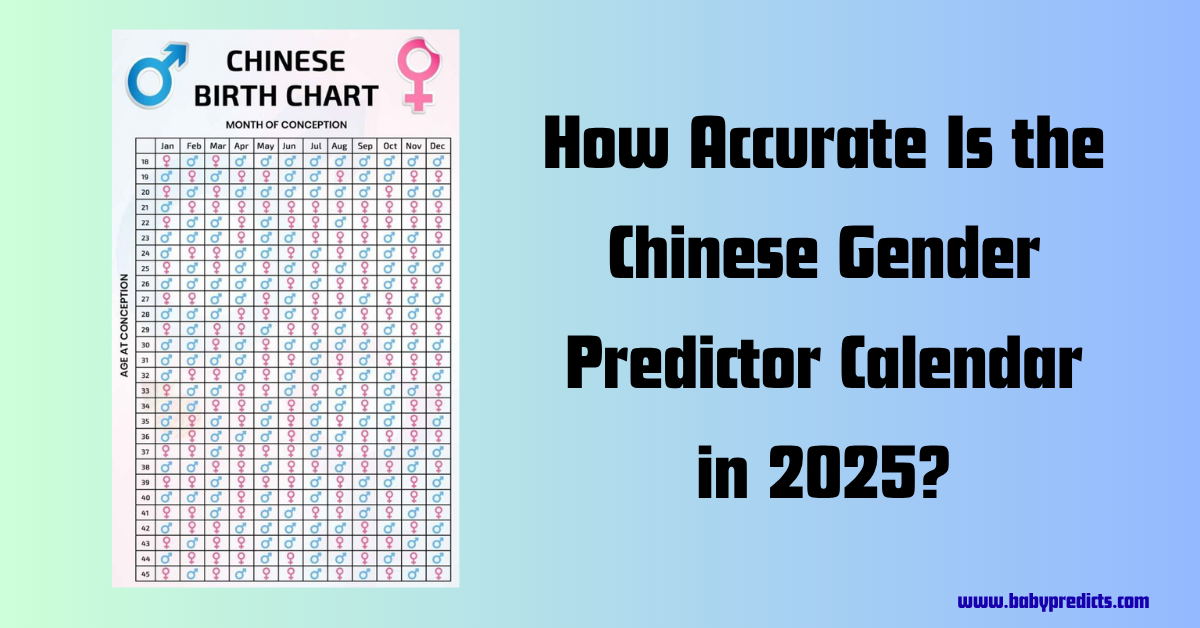
Are you an expecting parent wondering about your baby’s gender in 2025? The Chinese gender predictor calendar has long been a popular tool for guessing whether you’re having a boy or girl, blending ancient tradition with modern curiosity. At BabyPredicts.com, we dive into the accuracy of this fascinating method, exploring its origins, how it works, and whether it holds up in 2025. Let’s uncover the truth behind this cultural phenomenon and help you decide if it’s worth a try!
What Is the Chinese Gender Predictor Calendar?
The Chinese gender predictor calendar, also known as the Chinese birth chart or Chinese gender calendar, is an ancient method believed to predict a baby’s sex based on the mother’s lunar age and the lunar month of conception. Legend traces its roots to the Qing Dynasty (1644–1912), with stories suggesting it was discovered in a royal tomb near Beijing. This tool uses a chart that cross-references these two factors to forecast whether you’re expecting a boy or girl, making it a fun tradition for many families.
In 2025, the calendar remains a topic of interest, especially as parents seek early insights into their baby’s gender. Unlike medical methods like ultrasounds or DNA tests, this predictor relies on lunar calculations rather than science, adding to its mystique.
How Does the Chinese Gender Predictor Work?
Using the Chinese gender predictor is simple but requires a few steps:
- Determine Your Lunar Age: Your age in the Chinese lunar calendar is typically one or two years older than your Western age. Add one year if your birthday falls after the Chinese New Year, and another if you were born after the lunar New Year of conception.
- Identify the Lunar Month of Conception: Convert your conception date (about two weeks after your last menstrual period) to the Chinese lunar calendar, which follows the moon’s cycles.
- Consult the Chart: Match your lunar age with the lunar conception month on the Chinese gender predictor chart. The intersecting cell will indicate a predicted gender—boy or girl.
Online tools and apps, including those on BabyPredicts.com, simplify this process by handling the lunar conversions for you. It’s a quick, entertaining way to guess your baby’s sex, though accuracy remains a key question.
The Origins and Cultural Significance
The Chinese gender predictor calendar’s history is steeped in legend. Some believe it was used by imperial families to plan for male heirs, reflecting the cultural preference for boys in ancient China. Discovered over 700 years ago, it blends elements of Chinese astrology, the I Ching, and the Five Elements. While its exact origins are debated, its enduring popularity in 2025 shows its appeal as a cultural artifact, even without scientific backing.
For many, it’s more than a prediction tool—it’s a link to tradition, often shared among family members or used as a baby shower game. However, its lack of empirical evidence prompts a closer look at its reliability.
How Accurate Is the Chinese Gender Predictor in 2025?
The big question for expecting parents in 2025 is: How accurate is the Chinese gender predictor calendar? Claims of 90% to 95% accuracy circulate online, but scientific studies paint a different picture. Research analyzing millions of births suggests the calendar’s success rate hovers around 50%—no better than a coin toss. This aligns with the biological reality that a baby’s gender is determined by the father’s sperm (X or Y chromosome) at conception, a factor the calendar can’t influence.
Anecdotal evidence varies widely. Some parents swear by its predictions, with stories of multiple correct guesses, while others report it was wrong every time. The inconsistency likely stems from the chart’s reliance on lunar age and conception month, which don’t account for genetic or environmental factors. In 2025, with advanced medical options available, the calendar’s accuracy remains more folklore than fact.
Factors Affecting Accuracy
Several factors may explain the mixed results:
- Lunar Calendar Miscalculations: Errors in converting Western dates to lunar dates can lead to incorrect predictions.
- Sample Bias: Positive anecdotes may overshadow failures, skewing perceptions of accuracy.
- Random Chance: With only two outcomes (boy or girl), a 50% accuracy rate is expected by chance alone.
- Chart Variations: Numerous versions of the chart exist online, with differences in design or interpretation affecting outcomes.
In 2025, the lack of a standardized, original chart further complicates its reliability. This variability suggests the calendar’s “success” may often be coincidental.
Comparing the Chinese Gender Predictor to Medical Methods
For accurate gender determination, medical methods outshine the Chinese calendar:
- Ultrasound: Typically performed between 18–22 weeks, this offers 95–99% accuracy if the baby’s position allows a clear view.
- Non-Invasive Prenatal Testing (NIPT): Available from 10 weeks, NIPT analyzes fetal DNA in the mother’s blood with over 99% accuracy.
- Amniocentesis or CVS: These invasive tests, done for medical reasons, are nearly 100% accurate but carry slight risks.
In contrast, the Chinese gender predictor requires no medical intervention, making it a low-stakes, fun alternative. However, for parents planning nurseries or names, medical confirmation remains the gold standard in 2025.
Why People Still Use the Chinese Gender Predictor in 2025
Despite its questionable accuracy, the Chinese gender predictor calendar remains popular for several reasons:
- Early Fun: It offers a guess long before medical tests, adding excitement to early pregnancy.
- Cultural Connection: Many embrace it as a nod to heritage or tradition.
- Community Engagement: Sharing predictions with family or online forums like BabyPredicts.com fosters a sense of community.
In 2025, social media trends and baby prediction tools keep the calendar relevant, even as a playful diversion rather than a serious tool.
Tips for Using the Chinese Gender Predictor in 2025
If you’re tempted to try the Chinese gender predictor calendar, here are some tips:
- Use a Reputable Source: Stick to well-known sites like BabyPredicts.com for accurate lunar conversions.
- Double-Check Dates: Ensure your lunar age and conception month are correctly calculated.
- Keep Expectations Realistic: Treat it as entertainment, not a definitive answer.
- Combine with Other Fun Methods: Pair it with old wives’ tales (e.g., heart rate or food cravings) for a full prediction experience.
This approach maximizes enjoyment while minimizing disappointment if the prediction doesn’t match the outcome.
The Science Behind Gender Determination
Gender is determined at conception when a sperm carrying an X or Y chromosome fertilizes the egg (which always carries an X). This results in XX (girl) or XY (boy). Environmental or astrological factors, as implied by the Chinese calendar, have no proven impact. In 2025, advancements in genetics reinforce that only medical tests can reliably predict gender, underscoring the calendar’s limitations.
Potential Risks of Relying on the Calendar
While harmless as a game, over-reliance on the Chinese gender predictor can pose risks:
- False Expectations: Incorrect predictions may lead to disappointment or premature planning.
- Delayed Medical Care: Waiting for a “fun” method might delay critical prenatal screenings.
- Cultural Pressure: In some communities, gender preferences could amplify stress if the prediction conflicts with desires.
In 2025, experts recommend using the calendar for enjoyment only, alongside medical advice from healthcare providers.
Fun Alternatives to the Chinese Gender Predictor
If you enjoy gender prediction games, consider these alternatives:
- Old Wives’ Tales: Test myths like “carrying high means a girl” or “sweet cravings indicate a boy.”
- Mayan Gender Prediction: Based on mother’s age and conception year, offering another cultural twist.
- Ring Test: Suspend a ring over your belly and watch its swing (back-and-forth for boy, circular for girl).
These methods, like the Chinese calendar, are 50% accurate by chance but add a playful element to pregnancy.
The Future of Gender Prediction in 2025
As technology advances, gender prediction is becoming more precise. In 2025, at-home DNA kits and early NIPT options are gaining traction, offering accuracy within weeks of conception. The Chinese gender predictor, while charming, is unlikely to evolve beyond its current form, remaining a nostalgic tradition rather than a scientific tool.
Why Choose BabyPredicts.com?
At BabyPredicts.com, we provide reliable resources for expecting parents, including our Chinese Gender Predictor Tool and expert insights. Whether you’re exploring fun predictions or seeking medical advice, we’re here to support your journey. Try our tools today and join our community of moms-to-be!
FAQs About the Chinese Gender Predictor Calendar in 2025
Q: Is the Chinese gender predictor 100% accurate?
A: No, it’s not 100% accurate. Studies show it’s about 50% accurate, similar to a random guess, due to its lack of scientific basis.
Q: Can I use the Chinese gender calendar to plan for a boy or girl?
A: No, it can’t influence gender. A baby’s sex is determined by sperm chromosomes, not conception timing or lunar age.
Q: How early can I use the Chinese gender predictor?
A: You can use it as soon as you know your conception date, making it an early, non-medical option.
Q: Why do some people say it worked for them?
A: With only two outcomes, a 50% success rate is expected by chance. Positive experiences may reflect luck or confirmation bias.
Q: Is the Chinese gender predictor safe?
A: Yes, it’s safe as a fun tool, but it shouldn’t replace medical tests or influence serious decisions.
Q: How does the 2025 version differ from past years?
A: The chart doesn’t change annually; it uses the same lunar-based method, adjusted only by your input dates.
Q: Should I trust the Chinese gender calendar over an ultrasound?
A: No, ultrasounds (95–99% accurate) and NIPT (over 99% accurate) are far more reliable than the calendar’s 50% chance.
Conclusion
The Chinese gender predictor calendar in 2025 offers a fun, tradition-rich way to guess your baby’s gender, but its accuracy is no better than a coin toss. With a 50% success rate and no scientific foundation, it’s best enjoyed as a cultural game rather than a reliable method. For precise results, rely on medical options like ultrasounds or NIPT. Visit BabyPredicts.com for our Chinese Gender Predictor Tool and more resources to enhance your pregnancy experience. Embrace the journey with curiosity and confidence!